CO2 electronegativity difference
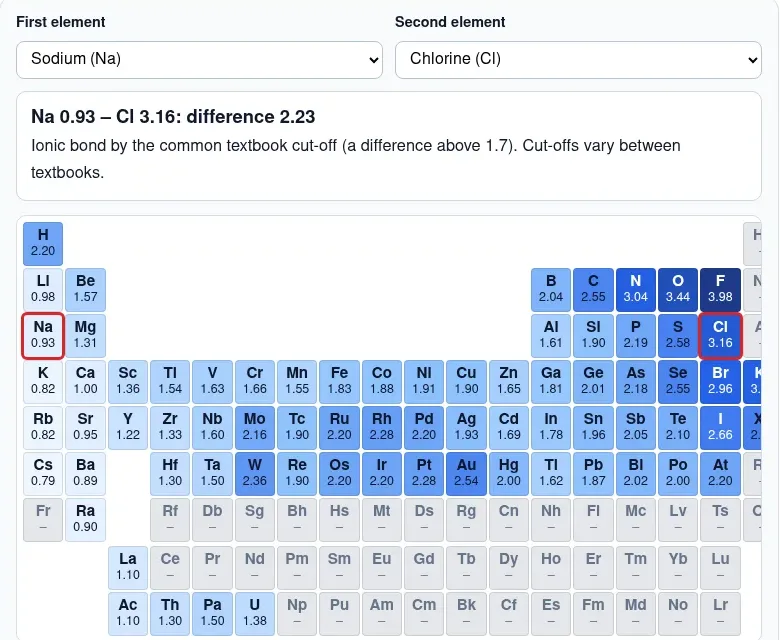
The C–O electronegativity difference in CO₂ is 0.89, so each carbon–oxygen bond is polar, but the molecule as a whole is nonpolar because its two bond dipoles point in opposite directions and cancel. Need values for other elements? Use the Pauling electronegativity values in the full chart.
Worked example: C 2.55 and O 3.44 give ΔEN = 3.44 − 2.55 = 0.89, which is polar covalent.
Polar covalent by the common textbook cut-off (a difference from 0.4 to 1.7).
Working out the difference
Take oxygen’s Pauling value, 3.44, and subtract carbon’s, 2.55. The difference is 0.89, which falls in the polar covalent range. So each C=O bond in carbon dioxide has a partial negative charge on oxygen and a partial positive charge on carbon.
The calculator above does the same subtraction for any two of the listed elements and applies the common cut-offs: under 0.4 nonpolar covalent, 0.4 to 1.7 polar covalent and above 1.7 ionic.
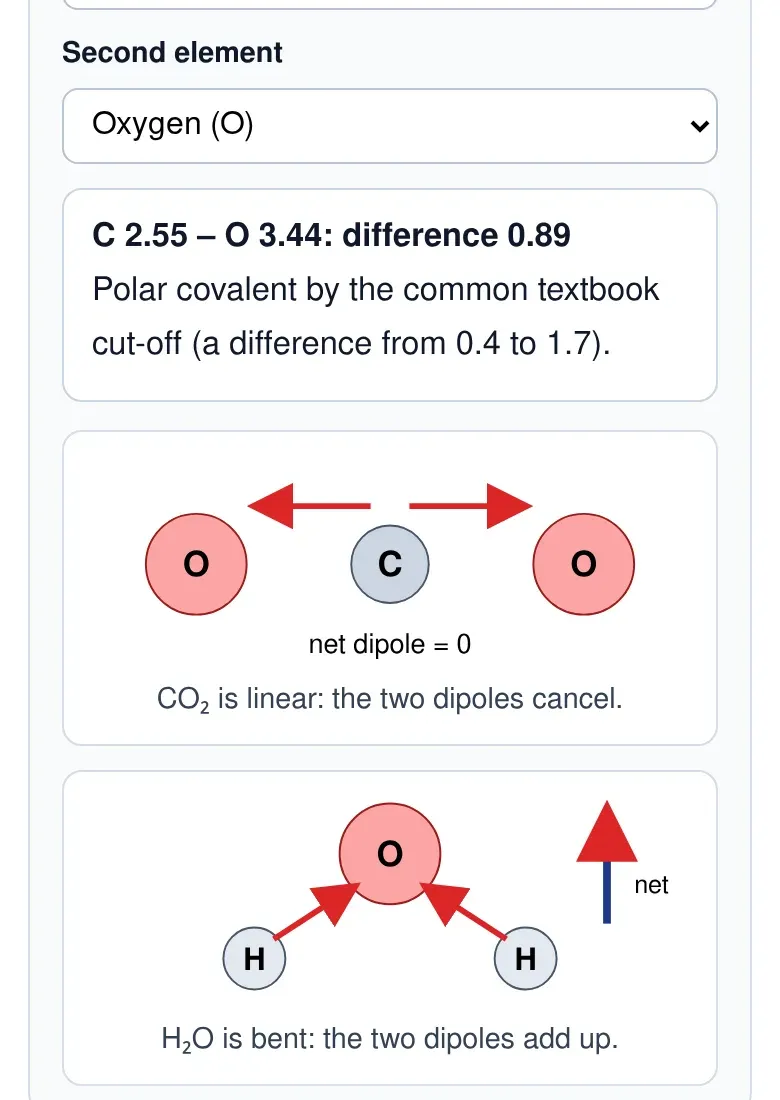
Why the molecule is nonpolar
CO₂ is linear, so its two bond dipoles point in opposite directions and cancel, leaving no overall dipole. Water has a similar bond difference but a bent shape, so its dipoles add up and it is polar. The table compares five molecules side by side, using the Pauling values and the shapes predicted by VSEPR theory; see the printable periodic table for the elements.
| Molecule | Bond ΔEN | Shape | Dipoles cancel? | Overall polar? |
|---|---|---|---|---|
| CO₂ | C–O 0.89 | Linear | Yes | No |
| H₂O | O–H 1.24 | Bent | No | Yes |
| SO₂ | S–O 0.86 | Bent | No | Yes |
| CH₄ | C–H 0.35 | Tetrahedral | Yes | No |
| NH₃ | N–H 0.84 | Trigonal pyramidal | No | Yes |
Carbon dioxide in water
Although CO₂ is nonpolar, a small part reacts with water to form carbonic acid, which is why soda tastes slightly acidic. Most dissolved CO₂ stays as molecules, and more dissolves under pressure and in cold water, which is why an opened soda goes flat as it warms.
This page is a study aid and does not replace your textbook or lab instructions; teachers may use slightly different reference values. Values are the Pauling-scale values on the Wikipedia data page “Electronegativities of the elements”, which follows Linus Pauling, The Nature of the Chemical Bond (3rd ed., Cornell University Press, 1960).
See the full chart of electronegativity or go back to the Periodic Table Printable.
Last updated: 18 November 2026.
Was this figure useful?
Mark it as passed, or send it back for revision with a short note.
Recorded. Thank you for the review.