Lewis Dot Diagram of NO2
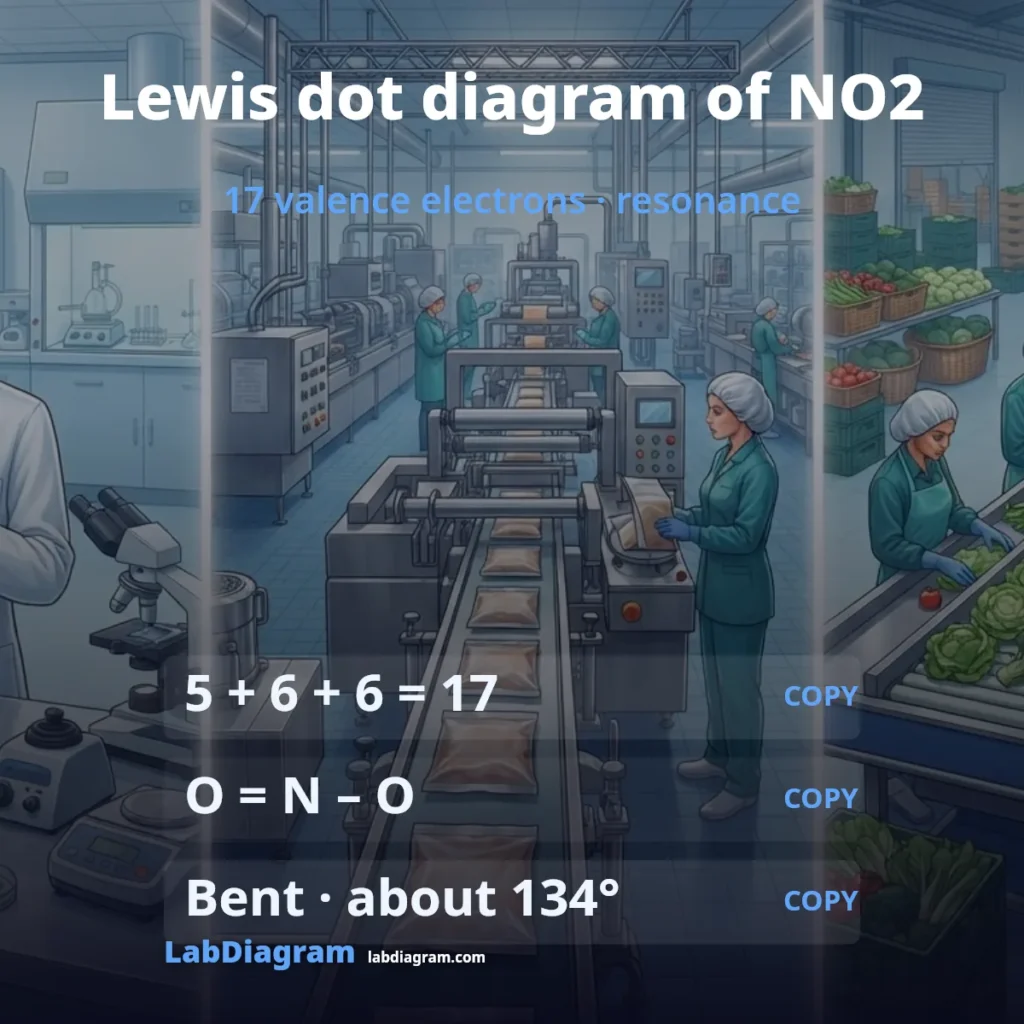
A Lewis dot diagram of NO2 shows nitrogen dioxide as one nitrogen bonded to two oxygens, with 17 valence electrons in total. Because 17 is odd, one electron stays unpaired on nitrogen, and the structure is a resonance hybrid of two forms. The viewer below also draws CH4, PH3, Cl2 and a carbon atom.
Lewis dot structure viewer
NO2 (nitrogen dioxide)
- Valence electrons: 5 + 6 + 6 = 17
- Bonds: 3 (one double, one single)
- Lone pairs / unpaired: 1 on the oxygen with the double bond ×2 and 3 on the oxygen with the single bond, plus one unpaired electron on N
- Shape: Bent (trigonal planar electron geometry)
- Approx. angle: about 134°
- Formal charges: N +1, double-bonded O 0, single-bonded O −1; the two oxygens swap roles in the resonance forms
NO2 has an odd number of valence electrons (17), so one electron stays unpaired on nitrogen. The structure can be drawn two ways that differ only in which oxygen has the double bond; the real molecule is a hybrid of both.
CH4 (methane)
- Valence electrons: 4 + 4×1 = 8
- Bonds: 4 single
- Lone pairs / unpaired: none on C
- Shape: Tetrahedral
- Approx. angle: 109.5°
- Formal charges: all atoms 0
Carbon shares one electron with each of four hydrogens, so every atom completes its shell and there are no lone pairs. The flat drawing is a convention; the real shape is tetrahedral.
PH3 (phosphine)
- Valence electrons: 5 + 3×1 = 8
- Bonds: 3 single
- Lone pairs / unpaired: 1 on P
- Shape: Trigonal pyramidal
- Approx. angle: about 93.5°
- Formal charges: all atoms 0
Phosphorus uses three of its five valence electrons for bonds to hydrogen and keeps the other two as a lone pair, which pushes the bonds into a pyramid.
Cl2 (chlorine)
- Valence electrons: 7 + 7 = 14
- Bonds: 1 single
- Lone pairs / unpaired: 3 on each Cl
- Shape: Linear (two atoms)
- Approx. angle: not applicable
- Formal charges: both atoms 0
Each chlorine shares one electron and keeps three lone pairs, so each ends with eight electrons around it.
C (carbon atom)
- Valence electrons: 4
- Bonds: none
- Lone pairs / unpaired: none; four unpaired valence electrons shown as dots
- Shape: single atom
- Approx. angle: not applicable
- Formal charges: 0
A Lewis dot diagram of a lone atom is the symbol with one dot per valence electron. Carbon is in group 14, so it shows four dots.
H2O (water)
- Valence electrons: 6 + 2×1 = 8
- Bonds: 2 single
- Lone pairs / unpaired: 2 on O
- Shape: Bent (tetrahedral electron geometry)
- Approx. angle: about 104.5°
- Formal charges: all atoms 0
Oxygen bonds to two hydrogens and keeps two lone pairs; the lone pairs squeeze the bond angle below 109.5°.
NH3 (ammonia)
- Valence electrons: 5 + 3×1 = 8
- Bonds: 3 single
- Lone pairs / unpaired: 1 on N
- Shape: Trigonal pyramidal
- Approx. angle: about 107°
- Formal charges: all atoms 0
Nitrogen forms three bonds and keeps one lone pair, giving a pyramid shape.
CO2 (carbon dioxide)
- Valence electrons: 4 + 6 + 6 = 16
- Bonds: 2 double
- Lone pairs / unpaired: 2 on each O
- Shape: Linear
- Approx. angle: 180°
- Formal charges: all atoms 0
Two double bonds let carbon and both oxygens reach eight electrons; with no lone pairs on carbon the molecule is linear.
O2 (oxygen)
- Valence electrons: 6 + 6 = 12
- Bonds: 1 double
- Lone pairs / unpaired: 2 on each O
- Shape: Linear (two atoms)
- Approx. angle: not applicable
- Formal charges: both atoms 0
A double bond and two lone pairs on each oxygen give eight electrons around each atom in the simple Lewis picture.
N2 (nitrogen)
- Valence electrons: 5 + 5 = 10
- Bonds: 1 triple
- Lone pairs / unpaired: 1 on each N
- Shape: Linear (two atoms)
- Approx. angle: not applicable
- Formal charges: both atoms 0
A triple bond and one lone pair on each nitrogen give each atom eight electrons.
HCl (hydrogen chloride)
- Valence electrons: 1 + 7 = 8
- Bonds: 1 single
- Lone pairs / unpaired: 3 on Cl
- Shape: Linear (two atoms)
- Approx. angle: not applicable
- Formal charges: both atoms 0
Hydrogen needs two electrons and chlorine eight; one shared pair and three lone pairs on chlorine do it.
Blue dots are lone pairs, the red dot is an unpaired electron, lines are bonds. The result for NO2 is shown before you choose anything.
Lewis dot diagram of NO2, step by step
- Count valence electrons. Nitrogen is in group 15 (5 electrons) and each oxygen is in group 16 (6 electrons): 5 + 6 + 6 = 17.
- Pick the central atom. Nitrogen is the less electronegative atom, so it goes in the middle with an oxygen on each side.
- Join the atoms with single bonds. Two bonds use 4 electrons, leaving 13.
- Fill the outer atoms. Give each oxygen three lone pairs (12 electrons), leaving 1 electron.
- Place the last electron on nitrogen. Nitrogen now has only 5 electrons around it: two bonds and one lone electron.
- Improve the octets. Move a lone pair from one oxygen into a second N–O bond. That oxygen now has a double bond and two lone pairs; nitrogen has 7 electrons around it, which is acceptable for an odd-electron molecule.
- Check formal charges. N: 5 − 1 − 3 = +1; double-bonded O: 6 − 4 − 2 = 0; single-bonded O: 6 − 6 − 1 = −1. They add up to 0, the charge of the molecule.
- Show resonance. The double bond can sit on either oxygen, so draw both forms with a double-headed arrow. The two N–O bonds in the real molecule are identical.
Worked example: counting electrons for NO2
Total valence electrons = 5 (N) + 2 × 6 (O) = 17. Bonds in the final drawing: one double bond (4 electrons) and one single bond (2 electrons) = 6 electrons. Lone pairs: two on one oxygen (4 electrons) and three on the other (6 electrons) = 10 electrons. Unpaired electron on nitrogen = 1. Check: 6 + 10 + 1 = 17.
Summary of the structures in the viewer
| Species | Valence electrons | Bonds | Shape | Approx. angle |
|---|---|---|---|---|
| NO2 (nitrogen dioxide) | 17 | 3 (one double, one single) | Bent (trigonal planar electron geometry) | about 134° |
| CH4 (methane) | 8 | 4 single | Tetrahedral | 109.5° |
| PH3 (phosphine) | 8 | 3 single | Trigonal pyramidal | about 93.5° |
| Cl2 (chlorine) | 14 | 1 single | Linear (two atoms) | not applicable |
| C (carbon atom) | 4 | none | single atom | not applicable |
| H2O (water) | 8 | 2 single | Bent (tetrahedral electron geometry) | about 104.5° |
| NH3 (ammonia) | 8 | 3 single | Trigonal pyramidal | about 107° |
| CO2 (carbon dioxide) | 16 | 2 double | Linear | 180° |
| O2 (oxygen) | 12 | 1 double | Linear (two atoms) | not applicable |
| N2 (nitrogen) | 10 | 1 triple | Linear (two atoms) | not applicable |
| HCl (hydrogen chloride) | 8 | 1 single | Linear (two atoms) | not applicable |
Valence electron counts use the group numbers in the IUPAC Periodic Table of the Elements (version dated 4 May 2022). Bond angles are approximate textbook values; measured values differ slightly between sources. These diagrams are educational simplifications.
Notation key for Lewis dot diagrams
| Symbol | Meaning | Unicode |
|---|---|---|
| • • | a lone pair drawn as two dots | U+2022 |
| • | one unpaired electron | U+2022 |
| — | a single bond (one shared pair) | U+2014 |
| = | a double bond (two shared pairs) | U+FF1D |
| ≡ | a triple bond (three shared pairs) | U+2261 |
| ⁺ | positive formal charge | U+207A |
| ⁻ | negative formal charge | U+207B |
| ↔ | resonance arrow between equivalent structures | U+2194 |
| ° | degree sign for bond angles | U+00B0 |
Other Lewis dot diagrams people ask for
Choose them in the viewer above: CH4 has four single bonds and no lone pairs, PH3 has three bonds and one lone pair on phosphorus, Cl2 has one bond and three lone pairs on each chlorine, and a carbon atom is the symbol C with four dots. Related shapes are explained on the molecular geometry chart.
Frequently asked questions
Why does NO2 have an unpaired electron?
Nitrogen dioxide has 17 valence electrons, an odd number, so they cannot all be placed in pairs. One electron stays on nitrogen.
Is NO2 linear or bent?
Bent. Nitrogen has three electron regions (a double bond, a single bond and the unpaired electron), which gives a trigonal planar electron arrangement and a bent molecule with an angle of about 134°.
Does NO2 follow the octet rule?
Not fully. Nitrogen has seven electrons around it in the usual drawing, so NO2 is one of the odd-electron exceptions to the octet rule.
How many resonance structures does NO2 have?
Two main ones, which differ only in which oxygen carries the double bond and which carries the negative formal charge.
More diagrams and tables are listed on chemistry charts. Diagrams are for education only.
Was this figure useful?
Mark it as passed, or send it back for revision with a short note.
Recorded. Thank you for the review.