Molarity Calculator
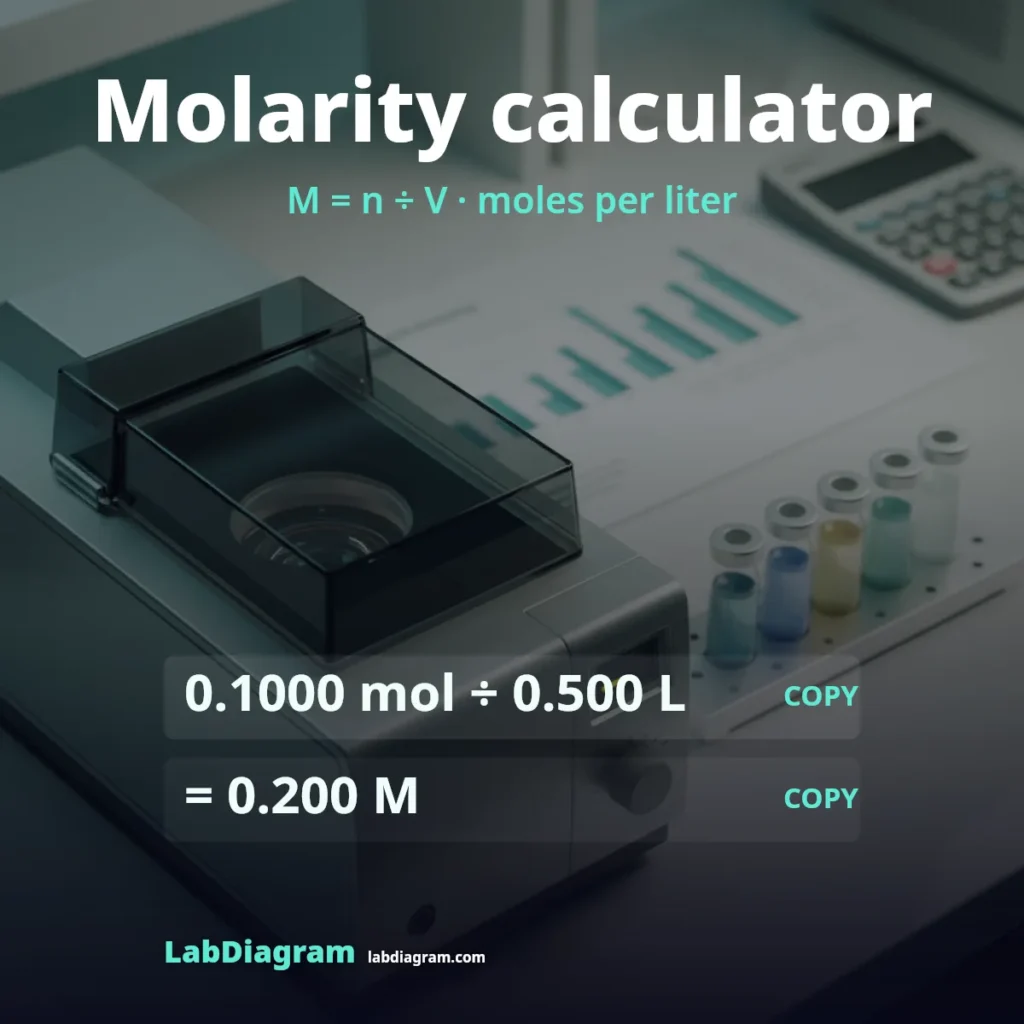
A molarity calculator finds the concentration of a solution in moles of solute per liter, M = n ÷ V. Choose a mode to get molarity from moles or mass, the grams needed for a target molarity, or the volume of stock for a dilution with M1V1 = M2V2.
Molarity calculator
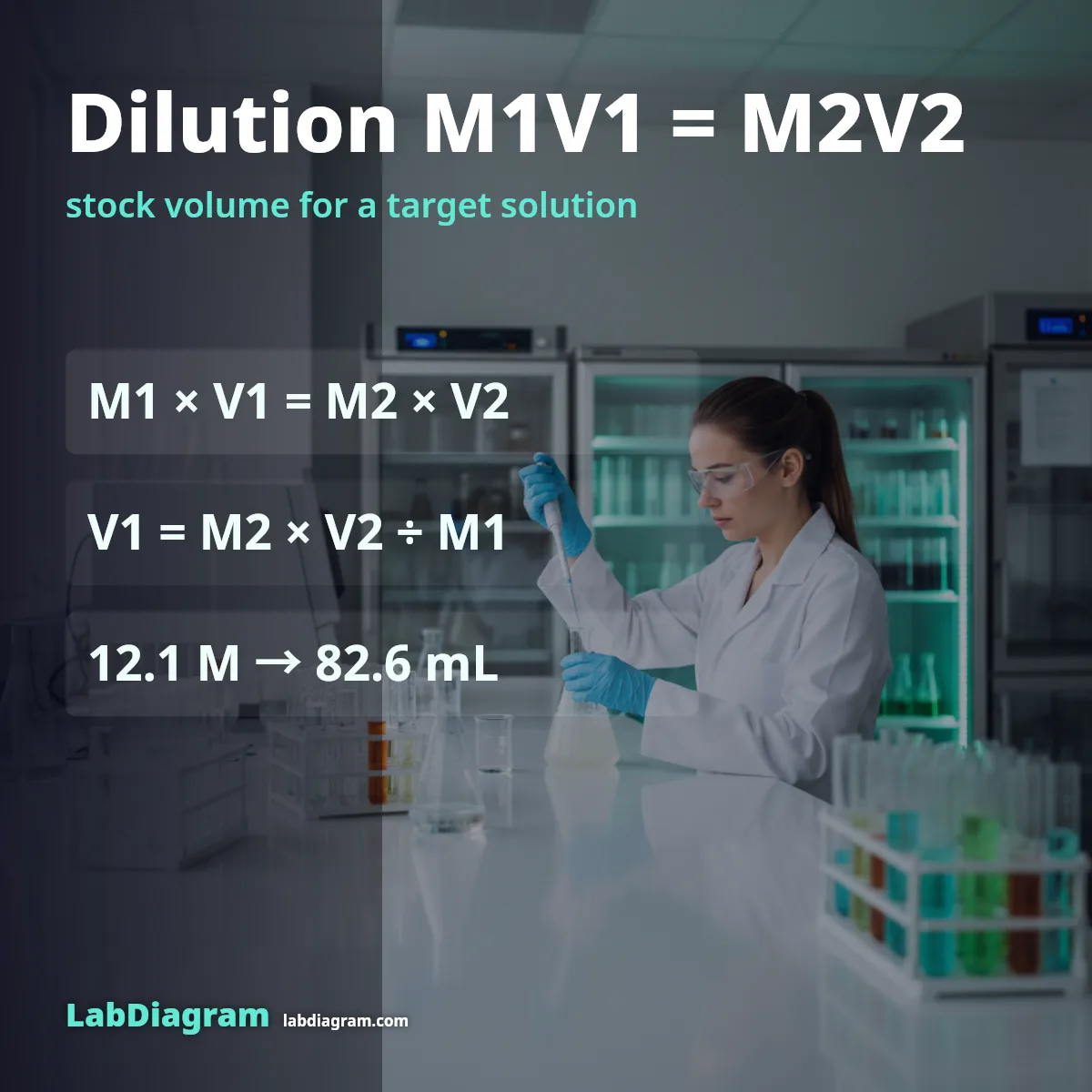
Molarity formulas
- Molarity M = moles of solute ÷ liters of solution.
- Moles n = mass ÷ molar mass.
- Dilution: M1 × V1 = M2 × V2, so V1 = M2 × V2 ÷ M1.
Worked example
Dissolving 5.844 g of NaCl (58.44 g/mol) in enough water to make 500 mL gives 0.1000 mol in 0.500 L, a 0.200 M solution. To make 1.00 L of 1.00 M HCl from 12.1 M stock, take 1.00 × 1000 ÷ 12.1 = 82.6 mL of stock and dilute to 1000 mL, adding the acid to water.
Molar masses of common compounds
| Compound | Formula | Molar mass (g/mol) |
|---|---|---|
| Sodium chloride | NaCl | 58.44 |
| Potassium chloride | KCl | 74.55 |
| Sodium hydroxide | NaOH | 40.00 |
| Hydrochloric acid (HCl) | HCl | 36.46 |
| Sulfuric acid | H2SO4 | 98.08 |
| Calcium chloride | CaCl2 | 110.98 |
| Sodium bicarbonate | NaHCO3 | 84.01 |
| Glucose | C6H12O6 | 180.16 |
| Potassium permanganate | KMnO4 | 158.03 |
| Copper(II) sulfate pentahydrate | CuSO4·5H2O | 249.69 |
Molar masses are rounded from IUPAC standard atomic weights. Use the exact value on your bottle label for anhydrous or hydrated forms.
Concentrated reagents
| Concentrated reagent | Typical strength | Approx. molarity |
|---|---|---|
| Hydrochloric acid | 37 % w/w | 12.1 M |
| Nitric acid | 70 % w/w | 15.8 M |
| Sulfuric acid | 98 % w/w | 18.4 M |
| Acetic acid, glacial | 99.7 % | 17.4 M |
| Ammonia solution | 28 % w/w | 14.8 M |
Approximate values for typical commercial grades; the label on your bottle gives the exact strength and density. Always add acid to water and wear eye protection.
Frequently asked questions
How do you calculate molarity?
Divide the moles of solute by the volume of solution in liters. If you have mass, first divide it by the molar mass.
What is the difference between molarity and molality?
Molarity is moles per liter of solution; molality is moles per kilogram of solvent. Molarity changes with temperature, molality does not.
How much solid do I need for 250 mL of 0.5 M NaCl?
0.5 mol/L × 0.250 L × 58.44 g/mol = 7.305 g.
Why add acid to water when diluting?
Mixing concentrated acid with water releases heat; adding acid to water keeps the heat spread out and avoids spattering.
Densities and unit conversions are on the density calculator. More on LabDiagram.
Was this figure useful?
Mark it as passed, or send it back for revision with a short note.
Recorded. Thank you for the review.